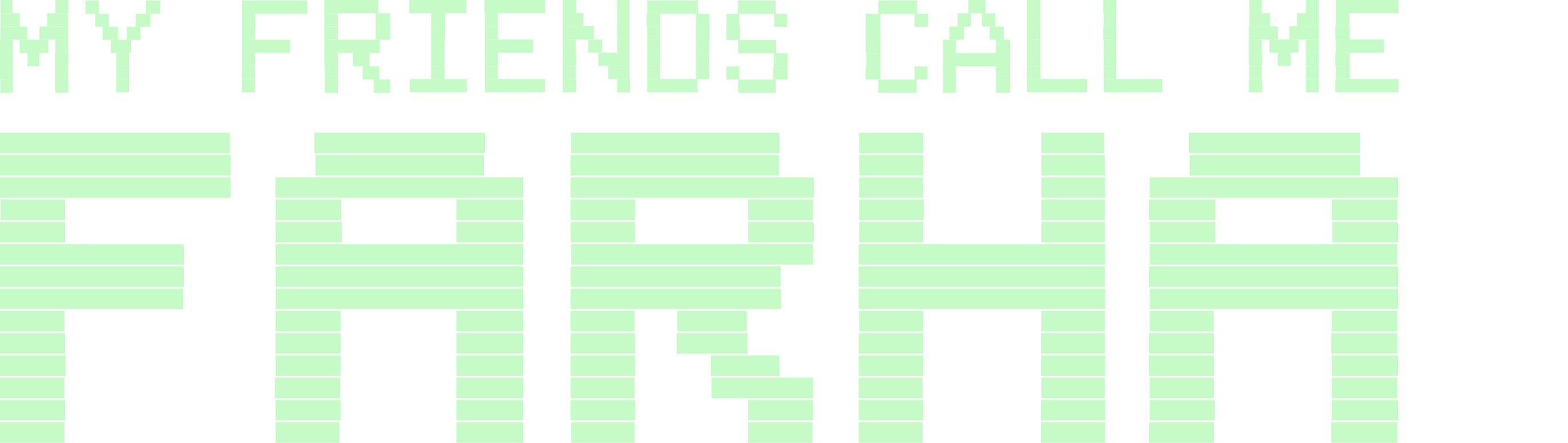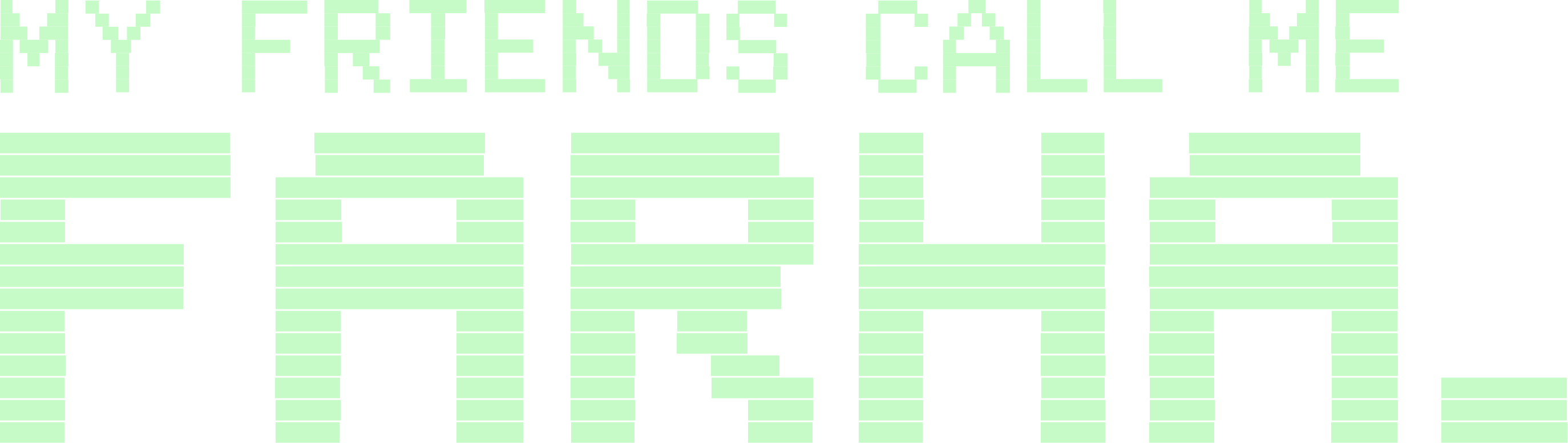
Twain existed before most of the products collected on this site.
It was a boutique agency I ran years ago.
When I decided to bring the name back, the obvious question was whether I was reopening the old company.
I was not.
That distinction made the revival possible.
A name can survive its original business model
The old Twain belonged to a particular period of my career.
It was a service business.
The work, clients, team structure and commercial model made sense for that version of the company.
Trying to recreate it now would have turned the revival into reenactment.
I did not want to rebuild an old agency because the name still meant something to me.
I wanted to ask whether the name could hold the kind of work I am doing now.
That led to a different definition:
An independent design, technology and product studio.
The sentence is broad enough to hold the practice.
It is also specific enough to reject the idea that Twain is simply “an agency again.”
Keep the DNA, change the organism
There are things from the old Twain worth preserving.
Independence.
A bias toward making.
Comfort moving between disciplines.
An interest in solving the actual problem rather than defending a departmental boundary.
Those qualities still fit.
The operating model does not have to.
The revived studio can contain client work, but it can also originate products and ventures.
It can build software.
It can create commissioned art.
It can develop specialist AI systems.
It can hold experiments long enough to determine whether they deserve to become something larger.
That is a very different shape from the business I ran before.
The continuity is in the behavior, not the org chart.
A studio is a useful container
I like the word studio because it does not prescribe one output.
A studio can design an identity in the morning and work on a product system in the afternoon without treating one of those activities as an exception.
That matters to me because my work has become increasingly difficult to divide into clean categories.
Design affects product behavior.
Technology affects proposition.
Brand affects interface.
Communication affects adoption.
The boundaries are real as disciplines, but they are not always useful as walls.
Twain gives that overlap somewhere to live.
Build ventures from inside the practice
Twain Editions is one example.
It takes visual composition, narrative, digital production and product thinking and turns them into a commissioned art product.
Agents is another.
It treats specialist AI capability as something that can be authored, packaged, evaluated and distributed.
Neither needs to pretend to be a traditional agency service.
They can be products created from within the studio.
That is an important difference in the revived model.
The studio is not only waiting for briefs.
It can write some of its own.
Do not use heritage as camouflage
Bringing back an old name creates an easy branding trap.
You can spend so much time telling the story of where the company came from that nobody understands what it is now.
I want the history to be present, but not dominant.
The revived Twain should not depend on nostalgia.
It should work for somebody who knows nothing about the earlier company.
The old story explains why the name matters to me.
The new work has to explain why the studio matters now.
The identity follows the same logic
The brand became simpler.
Lowercase.
twain.
A word and a terminal period.
There is something useful about the period.
It makes the name feel like a statement rather than an unfinished reference to the past.
The wider identity can still carry personality, but it does not need to imitate the era in which the first Twain existed.
Again, continuity does not require reconstruction.
Revival as editing
The most useful way I found to think about the process was not revival as restoration.
It was revival as editing.
Keep what still has value.
Remove what only made sense then.
Add what the current practice needs.
Do not preserve old assumptions simply because they have history.
That approach made Twain feel less like an old company being restarted and more like a name that had finally found its next form.
The point of bringing something back
There is no value in reviving a brand solely because it is familiar.
The revival has to create new capacity.
For me, Twain now provides a public container for work that moves between design, technology and products without requiring those things to be separated artificially.
It connects where I came from to the kind of practice I want to build now.
That is enough continuity.
The past is part of the identity.
It does not have to be the business model.